
Lead thought, improve public speaking & diversify your content.
Three weekly insights to get funding
Made me blush
A first-time author like me never gets tired of seeing my book reviewed like this:
“I’ve read this book cover to cover 4 times, and flip through it frequently when talking to others in the NPO world,” says Katt on Amazon. “It’s the first book that actually did a great job mixing comms, marketing and mission — instead of treating them like silos.”
“Highly recommend. If you’re like my org you’ll be rewriting your mission statement based on the recommendations here a few days after the book arrives, and finally understand how to simplify what you say to your audiences, both internal and external.”
— Kevin
💪🏽💛
Three insights
1. How to become a thought leader.
They all want you to be a thought leader.
You’re just trying to make payroll.
And that’s the pressure you’re under.
From your board, from your fundraising team, from the donors watching your every move, from yourself, from me. Deep down, you know in your gut that your own voice and visibility as a nonprofit leader are critical for raising money and advancing your mission.
But there’s no nonprofit CEO thought-leadership academy, and most books on the topic were written for Silicon Valley influencers rather than social sector leaders.
I didn’t have a roadmap.
I stumbled my way through this.
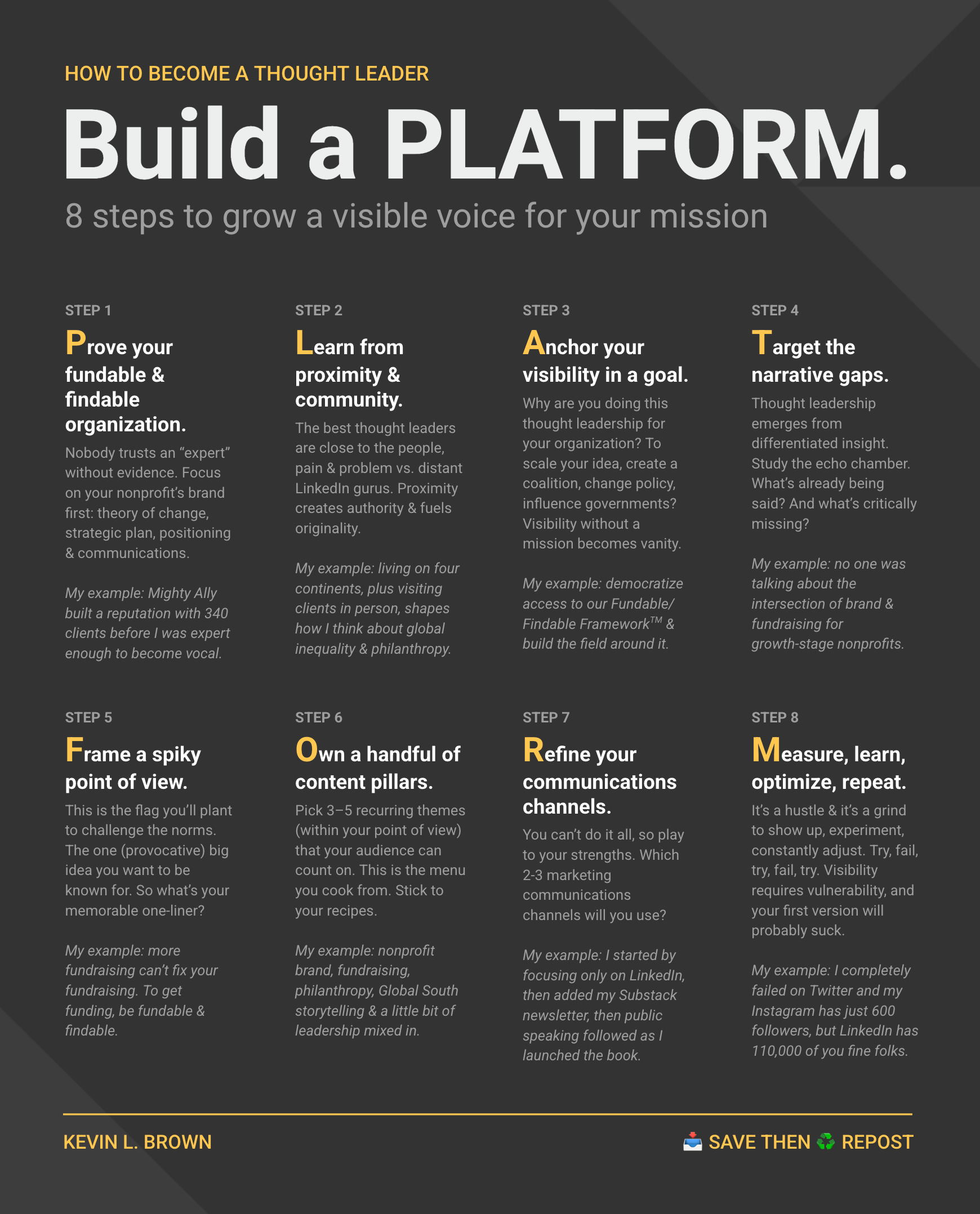
So I recently mapped my own process into this 8-step infographic.
It’s the work we’re doing at Mighty Ally: creating fundable and findable organizations and making you a fundable and findable leader.
Because movements need both a banner and a bearer.
Fundable.
Findable.
Followable.
2. From keyboard to keynote.
Death. Heights. Spiders.
No, the number 1 fear in the world?
Public speaking.
But there’s a simple way for you to improve, just like I did:
Write a lot and only talk about things you’ve typed. “Hardly any sentence in public comes out of my mouth, unless I’ve written it down once before,” says Neil deGrasse Tyson.
Why?
Your brain can only crystallize a unique point of view — and gain confidence in that perspective — when you’re forced to document it.
That’s why our Mighty Ally clients who are outstanding verbal communicators first find clarity through non-verbal communication.
Here’s my advice. ⤵
Before trying to be a conference panelist, join podcasts, or speak on any stage, you should regularly blog, post on social, or publish an email newsletter externally. Or even send a monthly staff memo internally.
My own keynotes (like this video above from the India Fundraising Conference) are much stronger after writing every day for three years.
Sounds obvious, right?
But it’s all too common for a leader to try to become a speaker before putting in the time to be a writer.
So pen your thoughts, then voice your impact.
From keyboard to keynote.
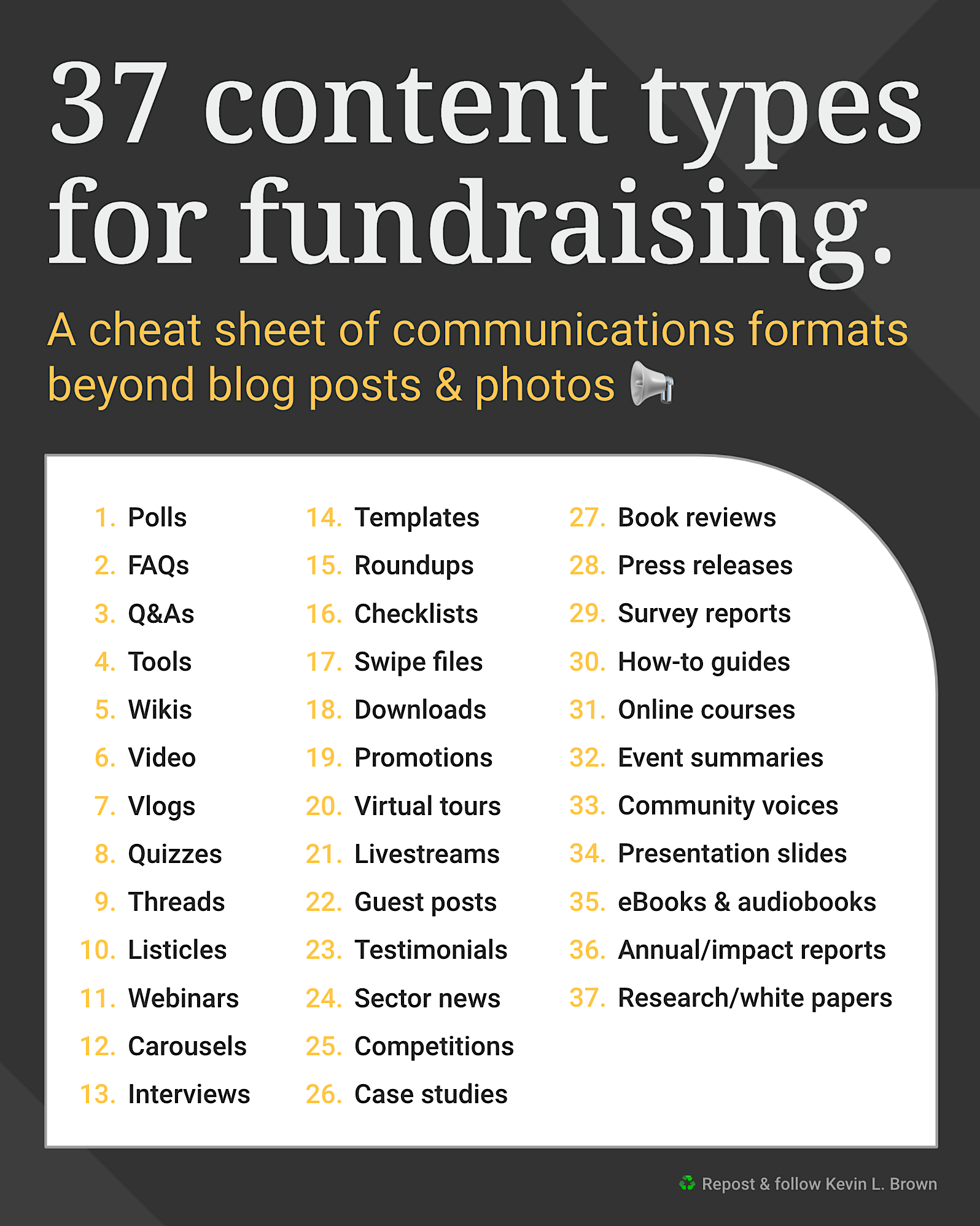
3. A cheat sheet of communications formats beyond blog posts & photos.
“Nike has said Just Do It every single day since 1988 and you’re afraid to reshare an old blog post from 6 months ago because people may have seen it?”
With that reframe from Ross Simmonds in mind, I believe your fundraising content doesn’t have to be so hard.
You might have enough content already.
Just repurpose your existing communications materials into different formats. For example, take your annual report and break it up into:
A case study for donors
A webinar for NGO partners
A video tour for website visitors
A how-to guide for other nonprofits
A presentation slides deck for media
A press release for government officials
A series of testimonials for the community
See which content types engage your donors.
37 formats, endless possibilities.
From the book
A line worth sitting with, from my four-time bestseller Fundable & Findable: The Brand-New Way to Fix Your Nonprofit Fundraising.

The weekly bonus

“Being the input is not the same as influencing the output,” says Yasmina ⵣ in her recent Substack essay:
why proximity to power is not power at all
“We are making the cage look beautiful, and that is a disservice to every brilliant young woman who deserves to know what she is actually walking into before she walks in.”
It’s an important reflection that needs to be shared.
P.S.
When your donors give you advice.
I love the comment about the one slide.
- When I was in corporate and had to present to the CEO, we started with a single summary slide that had the most important messages right up front, in case we had no time to get through the deck. Executives tend to like to control the narrative.
- I had one very wise boss who (15 years ago) promoted the "scary slide". This was the one slide that visually depicted the problem and why folks listening needed to act. For example- line charts going down, a picture of unhappy customers etc. That Scary Slide concept has stayed with me for almost a decade